In the rapidly evolving world of Epic Games’ battle royale phenomenon, few updates have sparked as much discussion as the v31.20 patch that landed halfway through Chapter 5 Season 4. Even two years later, the changes introduced in that late‑2024 update continue to echo through Fortnite’s competitive landscape, particularly when it comes to the delicate balance between controller and mouse‑and‑keyboard players.
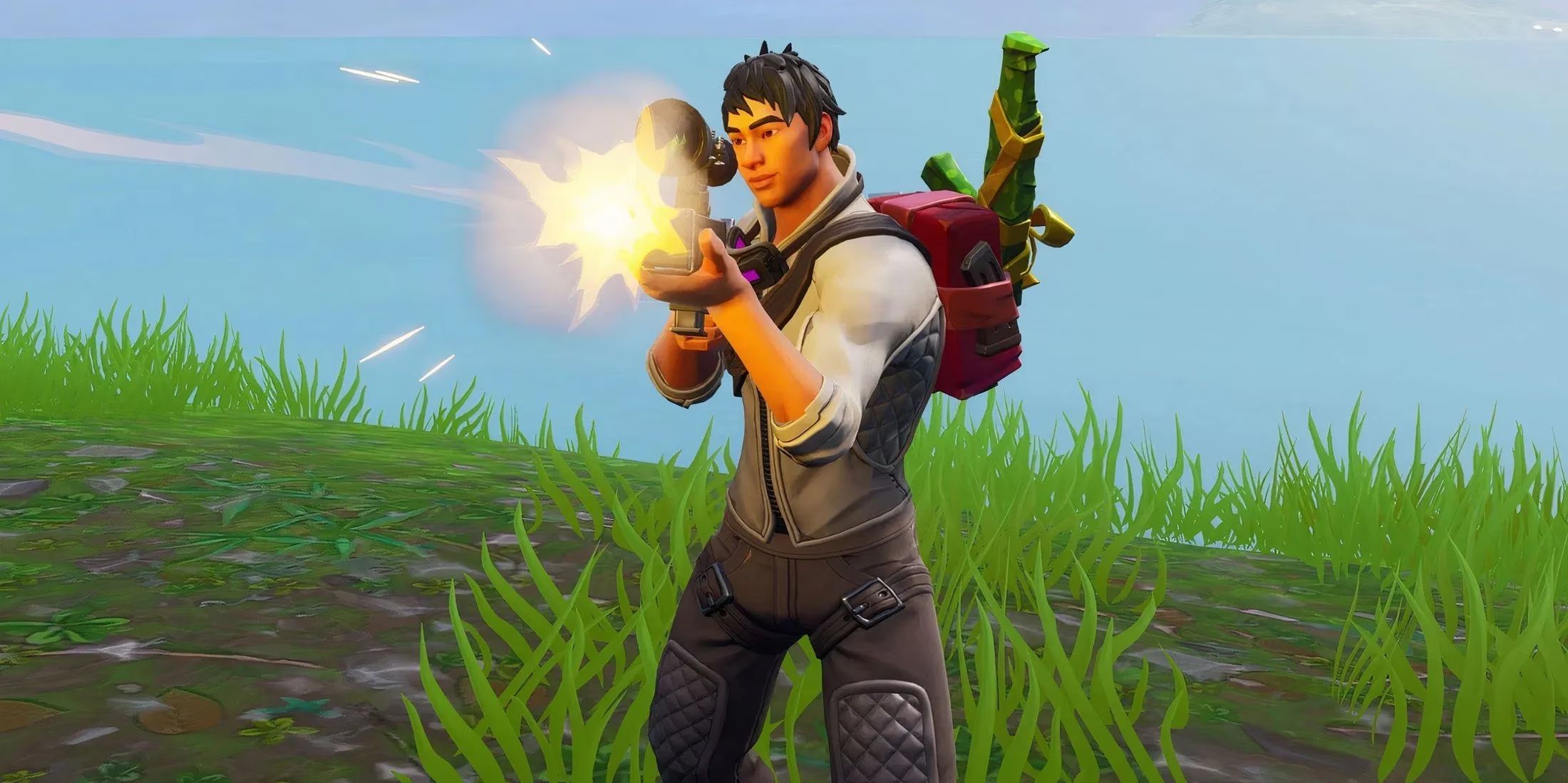
At the heart of the update was a significant retooling of aim assist, the controversial feature designed to help controller users track opponents. Developer Jibb Smart took to Twitter at the time to reassure the community that the goal was not to make aim assist outright stronger or weaker, but to strip away what he described as “superhuman” levels of assistance. Instead, the new system aimed to mimic human‑like tracking patterns, introducing subtle delays and acceleration curves that more closely resembled the natural motor limitations of a physical thumbstick. For many, this was a response to growing complaints that earlier versions had been stealthily buffed, allowing controller players to lock onto targets with almost robotic precision.
The v31.20 update arrived right in the thick of a Marvel‑themed season that had already brought back beloved superhero content, including themed Points of Interest, mythic items, and crossover skins. By that point, Epic had flooded the island with Stark Industries technology, culminating in a fresh suite of Iron Man gear. The patch officially introduced the Iron Man’s Combat Kit and Iron Man’s Flight Kit, empowering players to rain repulsor blasts from the sky while combining offensive and mobility options in a single loadout. The returning Stark Industries Energy Rifle rounded out the arsenal, giving fans a chance to relive the fantasy of being Tony Stark in the middle of a chaotic last‑circle scenario.
The mid‑season refresh didn’t stop there. A new limited‑time mode, Day of Doom LTM, split the lobby into two rival factions: the Avengers and Doctor Doom’s Henchmen. This asymmetric mode leaned heavily into the season’s narrative, offering a fresh way to experience Marvel’s clash of heroes and villains beyond the standard battle royale format. The mode encouraged team play and objective‑based strategies, diverging from the usual free‑for‑all tension and providing a welcome palate cleanser for both casual and competitive players.
Beneath the surface, however, the aim assist revision remained the most talked‑about change. Smart’s explanations emphasized a philosophy of realism over artificial dominance. “We want aim assist to feel like a natural extension of a player’s intent, not something that reacts faster than humanly possible,” he tweeted at the time. The system’s reticle friction and rotational help were tuned so that sudden direction changes or erratic opponent movement would no longer be tracked with zero latency. Instead, a fraction‑of‑a‑second processing delay was baked in, approximating the reaction time of a human player. This effectively narrowed the gap between the flick‑shot potential of a mouse and the assisted precision of a controller, though it also meant that controller users had to re‑learn muscle memory they had relied on for years.
Player feedback in the immediate aftermath was a mixed bag. Competitive controller players felt the nerf in close‑range box fights where tracking mattered most, while keyboard‑and‑mouse veterans applauded a more level playing field. True to the developers’ word, Fortnite did not leave the system untouched. Over the subsequent months, multiple hotfixes and tuning patches nudged the parameters based on aggregated data and community sentiment. By early 2025, the aim assist model had settled into a state that most considered fair, albeit slightly less forgiving than its pre‑v31.20 iteration. The iterative approach became a blueprint for how Epic would handle core gameplay adjustments in the future—rolling out bold changes, then rapidly iterating rather than letting imbalances fester.
Looking back from 2026, the v31.20 patch is often cited as a turning point in Fortnite’s accessibility and competitive integration. It acknowledged that while aim assist is essential for making a cross‑platform game inclusive, it should not artificially inflate the skill ceiling. The philosophy of “human‑like” tracking influenced not only subsequent battle royale chapters but also the game’s Creative and UEFN (Unreal Editor for Fortnite) modes, where custom map makers could now fine‑tune aim assistance settings to suit their specific experiences.
Beyond the mechanical tweaks, that update’s Marvel extravaganza set the stage for even bolder crossover events. Dataminers digging through the v31.20 files discovered an early texture for Billy the Puppet from the Saw franchise, hinting at a horror collaboration that would materialize during Fortnitemares later that year. The seamless blend of superhero spectacle and gruesome horror perfectly encapsulated Fortnite’s genre‑hopping identity, proving that the game could pivot from Iron Man’s high‑tech heroics to Jigsaw’s twisted games without missing a beat.
In hindsight, the aim assist overhaul was more than just a balance patch—it was a statement of intent. By making controller tracking feel less like an algorithm and more like a human player, Epic Games reinforced its commitment to fair competition while preserving the accessibility that brought millions onto the island. As Fortnite continues to evolve into 2026 with new chapters, modes, and crossovers, the lessons learned from v31.20 remain embedded in the game’s DNA: authenticity over artificiality, and a constant dialogue between developers and the community that keeps the battle bus rolling.